

24/7 Water Damage Restoration in Greeley, CO
Water spreading through a finished basement in Westgate is a different restoration job than a slow leak inside an older Arlington Park bungalow. Code 3 responds to both, 24 hours a day.
We provide water damage restoration throughout Greeley and the surrounding Weld County area, from burst pipes and appliance failures to sewer backups, mold, and commercial water losses. Our team traces the source, maps hidden moisture, dries the structure, removes unsalvageable materials, and can handle the rebuild when repairs are needed.
Call for 24/7 emergency water damage restoration in Greeley.
IICRC Certified | Licensed & Insured | Locally Owned | 12+ Years of Trade Experience
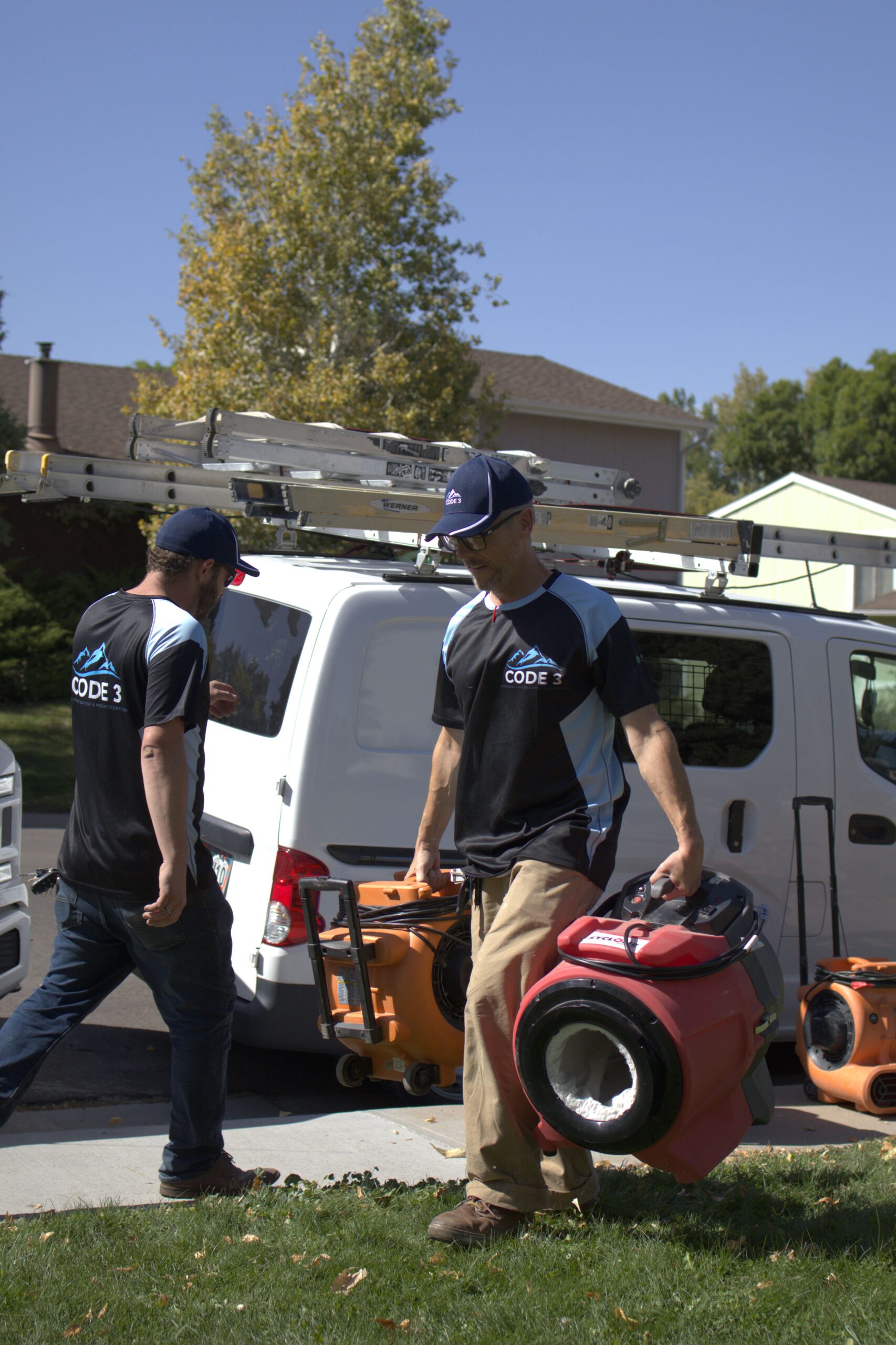
Water Damage and Mold Services in Greeley
Greeley water losses often involve frozen or burst supply lines, water heaters and appliance failures in finished basements, sewer or ditch-season backups, and larger commercial losses.
Code 3 provides water damage restoration services for homes, rentals, and businesses throughout Greeley. That includes:
- water extraction
- moisture mapping
- structural drying
- damaged material removal
- cleaning
- antimicrobial treatment
- source tracing
We also provide mold remediation when moisture has led to growth behind drywall, flooring, insulation, or finished basement walls. When repairs are required, our team’s remodeling background enables Code 3 to proceed with reconstruction rather than stopping once the property is dry.
Preventative services include:
- moisture monitoring
- exterior and window sealing
- basement protection
- insulation
- freeze protection
Our Water Damage Restoration Process
- Assessment and moisture mapping: We inspect the affected area, trace the likely source, and use moisture readings to identify water that has travelled beyond what is visible.
- Water extraction: Standing water is removed so structural drying can begin.
- Containment and material removal: Unsalvageable materials are removed. When mold or contaminated water is present, containment helps protect unaffected areas.
- Structural drying and monitoring: Drying equipment is placed based on the materials involved, and moisture levels are monitored through the process.
- Cleaning and treatment: Affected areas are cleaned and treated as needed.
- Source tracing: We look at why the water entered the property so the repair does not stop at the symptom.
- Reconstruction: Code 3 can repair and rebuild damaged areas in-house.
Frequently asked questions

Serving Greeley and the Surrounding Weld County Area
Code 3 serves properties across Greeley, including downtown and the Monroe Historic District, Glenmere, Cranford, Arlington Park, Alta Vista, Houston Heights, Belair Park, and Sherwood Park.
We also serve west Greeley neighborhoods, including Kelly Farm, West Point, Country Club West, Lake Bluff, Northridge Estates, and Westgate, plus Evans, Garden City, and nearby parts of Weld County.
Code 3 answers emergency calls right away. For active water losses, our team can typically be on site within 1–2 hours. Mold-related concerns are usually scheduled for an assessment the following day.
Elsewhere in Northern Colorado, Code 3 also provides restoration services in Loveland and Longmont. Response times depend on crew location, weather, traffic, and the nature of the emergency.


Why Choose Code 3 in Greeley?
Code 3 is locally owned and operated by Pat and Nate, with six years of owning and operating the company and more than 12 years of trade experience behind it. We are IICRC certified for water restoration, licensed and insured, and available 24/7.
The difference is what happens after drying. Water losses in older homes, finished basements, rentals, and commercial properties often require reconstruction. Code 3 can handle those repairs in-house instead of handing the project to another contractor, to restore the affected area to its original condition or better.
What Greeley Customers Say About Code 3


Why Greeley Properties See Water and Mold Problems
Greeley's Floodplain Is Bigger Than Many Property Owners Realize
The Cache la Poudre River is Greeley's best-known flood risk, but it is not the only regulated floodplain in the city. The floodplain also follows the South Platte River, Sheep Draw, Coal Bank Creek, Ashcroft Draw, John Law Ditch, and Sand Creek.
That means a property does not have to sit beside the Poudre to be exposed to mapped flood risk.
FEMA and the Colorado Water Conservation Board remapped the Cache la Poudre and South Platte floodplains, with the updated maps taking effect in 2023. Some Greeley property owners were newly mapped into flood zones.
Greeley saw flooding and evacuations in low-lying areas in 2013, although neighboring Evans was hit much harder. A May 1999 flood caused close to $3.5 million in direct damage and cleanup.
Irrigation Ditches Add Another Local Risk
Greeley's ditch network carries water through and around developed areas for much of the year, generally from about April through October. John Law Ditch itself carries regulatory floodplain through town.
Nearby properties can see lateral seepage, saturated soil, or ditch overtopping rather than a traditional river flood.
Older Neighborhoods and Newer West Greeley Fail Differently
Greeley's median construction year is 1985, but roughly one in ten homes predates 1950. Older housing is concentrated around downtown, the Monroe Historic District, Glenmere, Cranford, Arlington Park, Alta Vista, and neighborhoods near UNC.
Those properties may have galvanized and cast iron lines, clay sewer laterals, rubble or stone foundations, and partial or dirt-floor basements.
West Greeley has the opposite profile. In newer areas such as Kelly Farm, West Point, Country Club West, Lake Bluff, Northridge Estates, and Westgate, losses are more likely to involve supply-line fittings, appliance connections, and water heaters inside finished basements.
UNC Rentals Can Let a Leak Go Undetected
Greeley's rental density around the University of Northern Colorado creates another local pattern. Student rentals may sit unoccupied over winter break, allowing a leak to go unnoticed for days rather than hours.
A frozen supply line or slow leak can spread into areas that are not immediately visible. Moisture mapping helps landlords and property managers determine whether water has moved behind walls, under flooring, or into ceilings.
Expansive Clay, Freeze-Thaw Cycles, and Hidden Mold
Front Range soils can swell when wet and shrink as they dry. The Colorado Geological Survey documents expansive soils capable of swelling 10 percent or more and exerting pressures of 20,000 pounds per square foot or greater. Cracks and heaving in basement slabs can create paths for seepage.
Winter adds another source of stress through freezing temperatures and freeze-thaw cycles. Poorly insulated lines, exterior plumbing, and vacant properties are especially vulnerable. Understanding how frozen pipes fail in Northern Colorado can help property owners identify vulnerable areas before temperatures drop.
A dry climate can also hide moisture. Surfaces may feel dry while drywall, insulation, subflooring, or wall cavities remain wet. Mold needs moisture, not humid outdoor conditions, so proper drying depends on measurements taken inside the affected materials. This is also why mold can grow in a dry climate after an unresolved leak or water loss.
Need Water Damage Restoration in Greeley?
If water is actively damaging your home, rental, or business, the priority is identifying the source and determining how far the moisture has traveled.
Code 3 is available 24/7 for water damage restoration, mold remediation, and property recovery in Greeley and the surrounding Weld County area.